To a stranger,no website is a red flag. Websites for electricians,all in for £500
Your registrations, your callout terms and your number, up front and readable on a phone in a dark hallway, in five pages for £500 fixed.
- £500once, fixed
- No contractnothing to cancel
- You own itsite and domain
For electricians
What an electrician's website has to do
Built around the one decision your customer is actually making.
An electrician gets two completely different callers. One has a dead socket or a board that keeps tripping and wants somebody today. The other is costing out a rewire, a new consumer unit or a charger on the driveway, and is quietly deciding whether to hand a four-figure job and a set of house keys to a stranger. The same five pages have to serve both.
The second thing is proof, and it matters more here than in almost any other trade. Electrician is not a protected title in Scotland, so anyone at all can use the word, and plenty of customers know that. Naming the body you are registered with, in text, does more work than any amount of writing about quality and reliability.
- Your registration, named and numbered. SELECT or NICEIC, your insurance cover, and the fact you work to BS 7671. Written as plain text near the top, where a customer can read it and check it, rather than as a logo in the footer.
- The emergency job and the planned job, split. A tripping board at teatime and a full rewire are two different people reading the same site. One needs a number they can tap in two seconds. The other needs finished work, a process and a sense of how long you would be in the house.
- Landlord and letting agent work, said out loud. Private landlords in Scotland need an electrical safety inspection at intervals of no more than five years, plus a portable appliance test on anything they supply. Agents place that work in batches and they search for it by name.
- EV chargers and consumer units, if you do them. Both are searched for by name rather than by the word electrician. Grant-funded chargepoint work has to be done by an OZEV-authorised installer, so if you are one, that goes on the page as a fact.
- Where you actually travel. Named towns and neighbourhoods, so you come up when somebody two streets away searches for an electrician near them, rather than only when they already know your name.
The example
A £500 site for an electrician, built out in full
A joinery demo rather than an electrical one, and we would rather say that than pretend. The shape is the part that transfers: the number pinned in the header, insurance and credentials stated before any sales copy, six named job types, and a quote form with a job-type dropdown at the end.
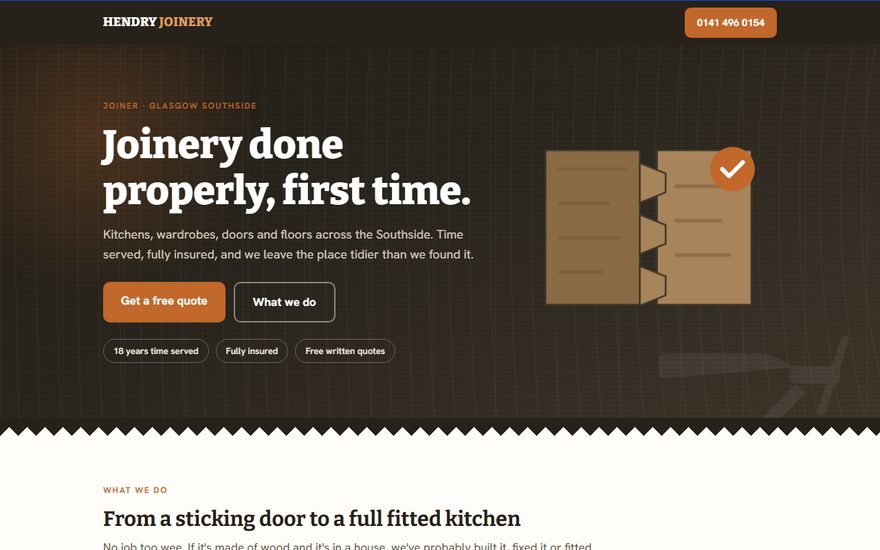
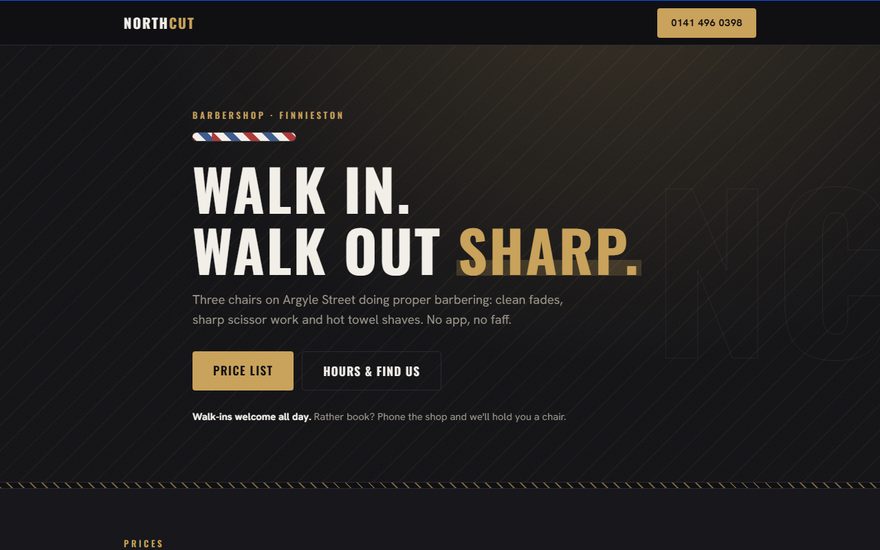
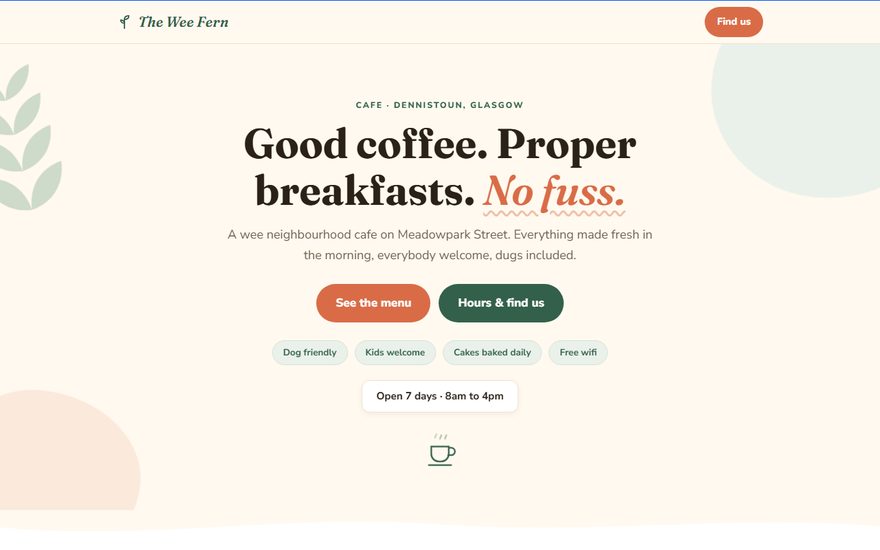

The same £500 build, written for a different trade: joiners, barbers, cafes, plumbers.
Worth avoiding
What most electrician websites get wrong
None of these are hard to fix. They just have to be noticed first.
Logos instead of numbers.
CommonA row of scheme badges with no membership number beside them proves nothing, because a badge is an image anyone can save. The number is the part a cautious customer can go and check.
Nothing at all for landlords.
CommonCondition report work runs on a five-year cycle and comes from people who own or manage more than one property, which makes it some of the most predictable work in the trade. Most electrician sites do not mention it once.
Copying an English site.
CommonPart P is England and Wales and has never applied in Scotland, where the equivalent is the Approved Certifier of Construction scheme run by SELECT and NICEIC. A page in Glasgow claiming to be Part P registered tells a knowledgeable reader the text came from somewhere else.
Compare the cost
Why £500 once beats "from £350"
Budget web packages advertise a low headline price, then tie you to a monthly direct debit for a year and a half. Here's how that actually adds up.
| Feature | Savvy Website | Typical pay-monthly package | DIY site builder |
|---|---|---|---|
| Up front | £500 | from £299 | £0 |
| Monthly fees | None you have to pay | £20–£30 a month | £13–£25 a month |
| Minimum term | None | Often 12 to 18 months | Rolling, but forever |
| Cost over 3 years | £540 | around £1,200 | around £700, and rising |
| Who writes the words | We do | Usually you | You |
| Your own domain | Included, first year | Sometimes included | Paid extra |
| Who owns it | You, outright | Usually them | You rent it |
| If you stop paying | Nothing happens | Site comes down | Site comes down |
Our three year figure is £500 plus roughly £20 a year for domain renewal after the first year. One like-for-like note: pay-monthly totals usually include an email inbox and ours doesn't. Email is an optional add-on, priced on request. We do offer optional care plans from £24.99 a month if you'd rather we looked after the site. It is never required, there is no minimum term, and the three year figures above assume you don't take it. Even allowing for that, the gap doesn't close. Comparison figures are typical advertised UK prices for budget and DIY packages in 2026, and minimum terms are those the providers publish themselves. Always check what your own quote includes.
The only clause that matters
£500 fixed. We don't get half of it until you're happy.
£500, fixed. Half gets the build started; the other half is due only once you've approved the finished site. If we can't get it right, you don't pay it, and the site still transfers to you.
- You approve it before the balance is due. Not the other way round.
- We carry the risk. If we can't get it right, you don't pay the balance.
- It's yours outright. Site and domain, both in your name.
The arithmetic, in full
Fixed. That is the whole cost of your website, and there are no monthly fees to us, ever.
- Today, to start the build
- £250
- Once you've approved it
- £250
- Monthly fees, either way
- None
Card, Apple Pay or Klarna, handled by Stripe. If you would rather get a price first, start there instead.
We don't get that second £250 until you tell us the site is right. If we can't get it right, you don't pay it, and the site still transfers to you.
After you're live · optional
Never want to think about this again?
Once your site is live it is yours. It keeps working whether you pay us another penny or not, and most owners simply renew the domain each year. If you would rather hand the upkeep over, there are two plans. Both are optional, month to month, and neither is mentioned on the call.
- Care plan, £24.99 a month. Hosting, domain, backups, three changes a month and a traffic report. For a site that is live and just needs looking after.
- Success plan, £99 a month. All of that, plus changes as you go, Michael directly rather than a ticket, and half an hour on the phone each month.
- Neither is required. The £500 does not depend on it, and we only raise it near the end of a build if we think it would genuinely help.
The bit that matters
You can take the site and never hear from us again.
Cancel any time, and the site stays yours. It does not come down, it does not get locked, and we hand over every login.
That is not how most monthly website deals work. The usual arrangement is a small setup fee, a direct debit, a minimum term of a year or more, and a site that stops being yours the moment you stop paying. Which is exactly why this is written here rather than buried in terms.
How it works
Four steps, and you're only ever committed to the one you're on
See a free preview
We show you a preview of what your site could look like before you spend a penny. If it's not for you, that's the end of it. No hard feelings.
Start the build
Like the direction? The first half, £250, gets the build under way. We have a quick call about your business so we can write your pages properly.
Site goes live
Your site goes live at your own address about a week after our call. You get up to two rounds of changes to get it just right.
Approve it, or walk away
Approve it and the last £250 completes the £500. If we've not got it right, you don't pay it. The deposit covers the work done and the site is still yours.
Where we work
Electricians across Glasgow, Edinburgh and central Scotland
We're one person on Glasgow's Southside, and the price is the same wherever you are.
Web design in Paisley
RenfrewshireThe biggest town in Scotland, with a proper high street to compete on.
Web design in East Kilbride
South LanarkshireScotland's first new town, with an older village still standing at the heart of it.
Web design in Hamilton
South LanarkshireSouth Lanarkshire's county town, built around Quarry Street and the Mausoleum.
Web design in Clydebank
West DunbartonshireShipyard town turned shopping town, from Kilbowie Road out to Faifley.
Web design in Bearsden
East DunbartonshireA Roman bath house at one end, Bearsden Cross and the shops at the other.
Web design in Motherwell
North LanarkshireA steel town with Strathclyde Park at one end and the Dalzell woods at the other.
Get a quote
Tell us what you do. We'll send back a price and a plan.
Two fields is enough to start. You'll have your price within one working day, and a free one-page plan for your electrical business alongside it. If the job's bigger than the £500 build, we'll tell you straight and quote it properly.
- A free plan comes with it. One page: where you come up on Google for what you do, who is above you, and the three things costing you calls. Yours to keep, whether you use us or not.
- We reply within one working day. Usually much sooner.
- No obligation, and no chasing. If it's not for you, that's the end of it.
- Rather just talk? Call or text Michael directly on 07508 750017, or message on WhatsApp.
If we emailed you first, the easiest thing is simply to hit reply.
Questions
What electricians ask before getting a website made
The example on this page is a joiner. Have you built one for an electrician?
Not yet, and we would rather say so than dress a joinery page up as something it is not. Hendry Joinery is a demo we built to show what £500 buys, and it is the nearest thing we have: a one-man trade, a phone number in reach the whole way down, credentials stated before any selling, the area listed by name and a quote form at the end. Yours would be the same thinking, laid out across your five pages, with electrical work in place of joinery.
Can I put my registration number and my certificates on the site?
Yes, and it is one of the few things on a trade site that genuinely changes minds. We put the body you are registered with and your number in readable text near the top, not as a logo in the footer, because text can be read by a customer, by a letting agent skimming for it and by Google. If you issue installation or minor works certificates as a matter of course, we say that too.
Nearly all my work comes from callouts. Is a website worth it?
Callouts are what a small site is best at. That search happens on a phone, in a hurry, usually by somebody who has never heard of you, so the only things that decide it are whether the page loads, whether the number is a tap and whether your hours and callout terms are visible without scrolling. None of that needs a big website. It needs a fast, plain one.
What does the £500 actually cover?
Five pages, every word written for you from one 20 minute phone call, your own domain for the first year, hosting, the security certificate, backups and the Google setup. Half up front, half only once you have approved it. There is no contract and no monthly fee you have to pay. The full breakdown is here.
How long does it take?
About a week from our phone call to going live, with up to two rounds of changes after that to get it right. More questions answered here.